

Give every old URL one clear outcome, review each destination by hand, and prove redirects reach the right page, not just a working one.
The new site is nearly ready. The developer says the redirects are done: every old URL now lands on a page that loads.
That proves the redirects work. It does not prove they send people and search engines to the right page. A product that lands on its category, or a service page that lands on the homepage, also “works”.
The short version. Give every old URL one of five outcomes, write down why, and have a person check each destination against what the old page did. Then test the map twice: against staging before launch, and hop by hop on the live site after it.
What Google asks for
| Google’s guidance | What it means for your map |
|---|---|
| Decide where each old URL should redirect, once you have the list (Google). | The map is a list of decisions, one per URL, not one catch-all rule. |
| Use server-side permanent redirects, such as 301 or 308, where possible (Google). | A permanent redirect tells Google the target should be shown in results; a temporary one does not (Google). |
| Content you are not moving should return 404 or 410 on the new site (Google). | Removal is a valid outcome. It needs a reason, not a redirect. |
| Don’t send many old URLs to one irrelevant page, such as the new homepage: it can confuse users and might be treated as a soft 404 (Google). | A working redirect to the wrong page can still lose the page. |
| Content merged from several pages into one may redirect to that consolidated page (Google). | Many-to-one is fine when the new page really covers each old one. |
| Redirect to the final destination directly; if you can’t, keep chains short (Google). | Destinations must not be old URLs that redirect again. |
| Keep redirects as long as possible, generally at least a year (Google). | Plan where the map will live after launch. |
Google also advises changing one thing at a time, so a new domain and a new design are not launched together (Google). If you can’t split them, the map matters even more.
Step 1 · List every old URL that matters
A crawl alone misses pages. Google suggests these sources (Google):
- Your sitemaps.
- The Links report in Search Console, for pages with internal and external links.
- Server logs or analytics, for the URLs that get the most traffic.
- Your CMS.
- Images, videos, JavaScript and CSS files, which move like any other URL.
Keep clicks, sessions or links beside each URL. They decide what gets reviewed first.
Step 2 · Give each URL one outcome
| Outcome | Use it when | Response | Proof the reviewer wants |
|---|---|---|---|
| Unchanged | The URL stays exactly the same. | 200 on the new site, no redirect. | Same path, same content, canonical to itself. |
| Moved | The same page now lives at a new address. | 301 or 308 to the new URL. | The new page is the same product, service or article. |
| Consolidated | Several old pages were merged into one. | 301 or 308 to the merged page. | The merged page covers what each old page covered. |
| Replacement | The old thing is gone, and a different page does the same job. | 301 or 308 to the replacement. | A visitor who wanted the old page would accept this one: a successor model, a renamed service. |
| Removed | Nothing on the new site serves the need. | 404 or 410. | A stated reason, and no internal links still pointing at it. |
If you can’t name a replacement, the honest outcome is Removed. A redirect to a category or the homepage “just in case” is the mistake Google warns about.
Step 3 · Review each destination, not just the redirect
A reviewer reads the old page and the proposed destination side by side and asks:
| Question | Fails when |
|---|---|
| Does it answer the same need? | A product goes to its category; a branch page goes to “Contact us”. |
| Is it the same thing? | A size, model or location changes without anyone deciding it should. |
| Is it the final URL? | The destination is itself an old URL, so a chain or a loop forms. |
| Will it be live and indexable at launch? | It returns an error, is noindex, or its canonical points somewhere else. |
| Is the homepage used? | Without a written reason, treat it as a failure. |
| Is it many-to-one? | Several sources share one destination without a consolidation decision. |
| Does the query string matter? | Filter or tracking parameters are dropped or kept by accident. |
Record the reviewer’s name and the date in the map. A row nobody has reviewed is still a proposal.
Example: a sample redirect map
Illustrative example, not real data. An invented Nairobi furniture store, example.co.ke, moving from old category-based URLs to a new store structure. Verification results use Ndovu’s validation labels.
| Old URL | Outcome | Destination | Reason | Reviewer | Verification |
|---|---|---|---|---|---|
| /about-us/ | Unchanged | (same URL) | Page kept as is. | W. Otieno | OK |
| /category/sofas/l-shaped-sofa-grey/ | Moved | /sofas/l-shaped-sofa-grey/ | Same product, new path. | W. Otieno | OK |
| /category/sofas/3-seater-velvet/ | Moved | /sofas/3-seater-velvet/ | Same product, new path. | W. Otieno | Wrong target: lands on /sofas/. Fix the rule. |
| /blog/choosing-a-sofa/ and /blog/sofa-fabrics/ | Consolidated | /guides/sofa-buying-guide/ | Both merged into one guide. | A. Njeri | OK, many-to-one approved |
| /category/beds/mvule-bed-2019/ | Replacement | /beds/mvule-bed/ | Discontinued; the current Mvule bed is the same design. | A. Njeri | Redirect chain: goes via /beds/mvule-bed-2020/. Point straight at the final URL. |
| /mombasa-showroom/ | Removed | 410 | Showroom closed in 2026; no replacement page. | A. Njeri | Removed as intended |
| /category/offers/black-friday-2024/ | Removed | 404 | Expired campaign. | W. Otieno | Lands on the homepage: an old plugin rule still redirects it. |
| /category/tables/?colour=oak | Moved | /tables/?colour=oak | Filter kept on the new store. | W. Otieno | Temporary (302/307) redirect: change to 301. |
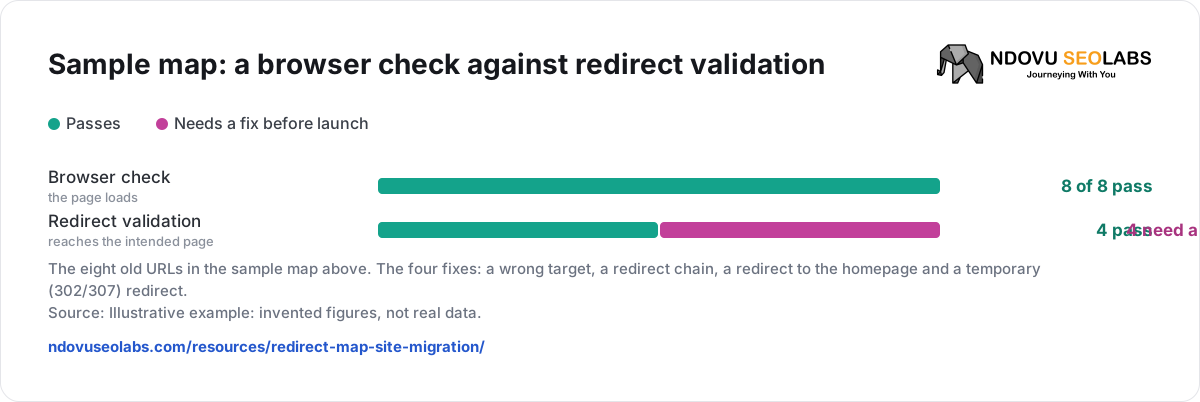
Every row “works” in a browser. Four of the eight still need a fix before launch, and none of the four would show up as an error.
Sample map: a browser check against redirect validation


- Passes
- Needs a fix before launch
The eight old URLs in the sample map above. The four fixes: a wrong target, a redirect chain, a redirect to the homepage and a temporary (302/307) redirect.
Source: Illustrative example: invented figures, not real data.
A header you can copy
old_url,outcome,destination,status,reason,reviewer,reviewed_on,verification_result,verified_on
/category/sofas/l-shaped-sofa-grey/,moved,/sofas/l-shaped-sofa-grey/,301,"Same product, new path",W. Otieno,2026-11-10,OK,2026-11-12
Outcome is one of unchanged, moved, consolidated, replacement or removed. For removed rows, put 404 or 410 in the status and leave the destination empty.
Use it in Ndovu
Ndovu’s Migration Monitor (sidebar → Site health → Migration Monitor → New migration) keeps the map, the review and the checks in one place.
| Stage | Where | What it does |
|---|---|---|
| List URLs | URL Inventory | Collects old URLs from the crawl, sitemaps, Search Console, Bing, verified crawler logs, GA4 and your uploads, deduplicated. |
| Propose | URL Mapping → Upload redirect map or Suggest mappings | A CSV of source, destination (or 404/410) and optional status, or exact, prefix and regex Mapping rules. Everything imports as Proposed. |
| Review | Review mappings | Approve, Reject, Set 410, Set 404, Set destination or Approve many-to-one. The homepage needs a written justification. |
| Catch conflicts | Conflicts in the map | Redirects without a destination, homepage redirects without a reason, off-site destinations, self-redirects, chains, loops and unapproved many-to-one. |
| Export | Export for review | Mapping CSV, Nginx, Apache .htaccess, WordPress (Redirection CSV) or Cloudflare Bulk Redirects CSV. Proposed rows are left out unless you tick them in. Ndovu never changes your live server’s redirects. |
| Pre-launch | Redirect validation and Pre-Migration Audit | Checks each destination is live, indexable, canonical to itself, not redirecting again and still carrying the old content. There is no single readiness score. |
| Post-launch | Launch Monitor and Post-Migration | Follows every old URL hop by hop. Reviews at 24 and 72 hours, then 7, 14, 30, 60 and 90 days. |
Step 4 · Verify before and after launch
Before launch
- Run the map against staging and check every destination exists, returns 200, is indexable and has a self-referencing canonical.
- Check no destination is itself an old URL.
- Fix every Wrong target, chain and homepage row, then re-run.
After launch
- Request each old URL and follow every hop. Pass only when the final URL is the intended destination, with one permanent redirect.
- Test key URLs with Search Console’s URL Inspection tool; use scripts or a crawler for the rest (Google).
- Watch Search Console for a rise in “Not found” errors. Google says it often sees redirects to wrong or non-existent URLs (Google).
- Compare the old and new sitemaps’ indexed counts, and check new URLs start earning impressions and clicks.
Expect some fluctuation. Google says a medium-sized site can take a few weeks or more for the new URLs to replace the old ones (Google). Progress is the old URLs falling out while the new ones pick up the same queries.
| When you need to… | Read |
|---|---|
| Set up a migration in Ndovu | Monitor a site migration |
| Audit the new site before launch | Run a site audit and verify fixes |
| Decide which audit issues to fix first | How to prioritise a technical SEO audit |
| Diagnose new URLs that are not indexed | How to diagnose indexing problems |